How to See the Aurora in Vík Yourself
Nobody sells this part, so here it is in full. Three things decide your night: cloud, darkness and geomagnetic activity, in that order of importance.
The clear-sky rule comes first
A strong aurora behind thick cloud is an invisible aurora. Start every check with the cloud map on vedur.is, the Icelandic Met Office site, where green areas mark cloud and white areas mark clear sky. Slide through the hours and look for a white patch anywhere within an hour's drive of Vík, not only over the village itself.
South-coast weather moves fast, which cuts both ways. A solid overcast at 9 p.m. can break by midnight. Set an alarm, look out of the window, go back to bed if it is grey. People who commit to one long vigil at 10 p.m. and give up at 11 miss more displays than people who check four times in pyjamas.
The same page carries the aurora activity number for midnight on a 0 to 9 scale, along with darkness, sunrise and moon times. Those clock times are calculated for Reykjavík, so treat them as approximate for Vík, which sits further east and gets dark a few minutes earlier.
The Kp index, and what it does not promise
The Kp index runs from 0 to 9 and measures geomagnetic activity. Higher means brighter and further south. Kp 3 already produces a steady band over Iceland on a clear night, Kp 5 counts as a minor storm, and anything above 5 is rare.
The number is a forecast, not a schedule. Displays get photographed in Iceland at Kp 0 to 2, and a Kp 5 evening with a full overcast delivers nothing. Treat the Kp figure as the answer to "how good could tonight be" and the cloud map as the answer to "will I see any of it".
The forecast horizon is short. Three days ahead is the practical limit for cloud and activity together, so the 27-day outlooks circulating online are a curiosity rather than a planning tool. Book your nights in Vík for the darkness, then read the forecast on the day.
Moon phase changes what you can see
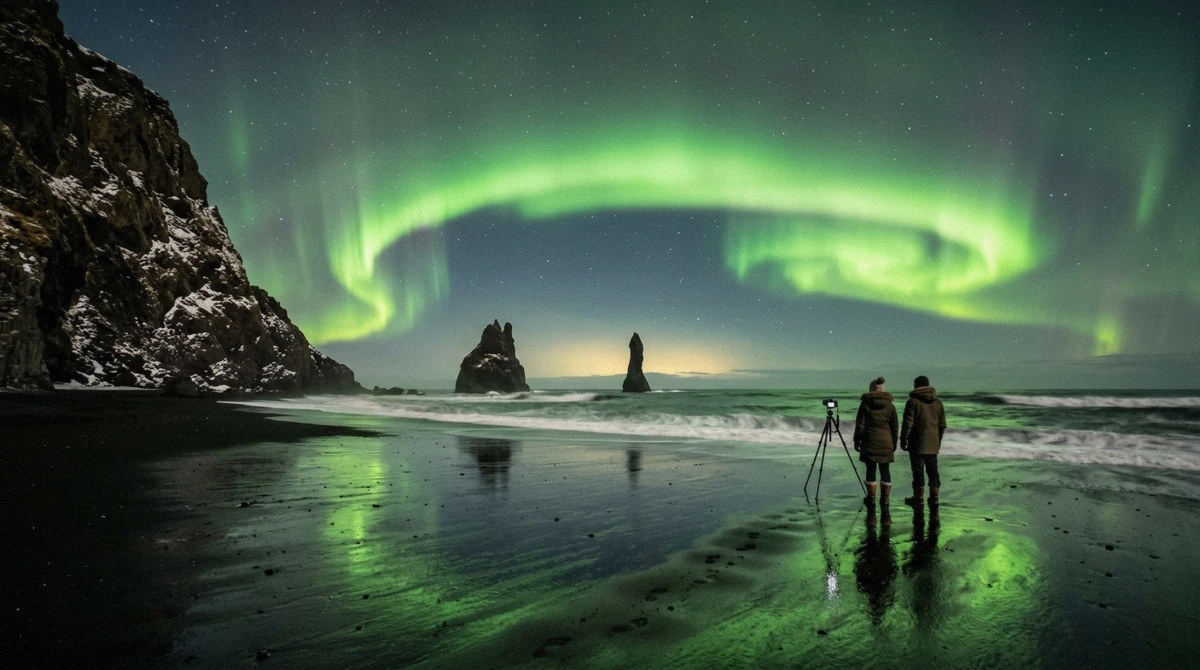
A new moon leaves the sky at its darkest, and that is when a faint arc across the north still registers to the naked eye. A full moon washes those faint displays out entirely, though a Kp 5 storm cuts through regardless and moonlight lights the black sand and the sea stacks in a way that many photographers prefer.
If your dates are flexible, aim for the week around new moon. If they are not, the moon is not a reason to stay indoors.
What to open on your phone
Keep it to three sources and check them in order.
- vedur.is aurora page: cloud cover map plus the 0 to 9 activity figure, from the Icelandic Met Office
- Hello Aurora: an Icelandic app with live sightings reported by other users, which is the closest thing to a local telling you to go outside
- My Aurora Forecast: Kp forecasts and alerts, useful for the push notification at 1 a.m. when you are asleep
- A window: the cheapest instrument on the list, and the only one that never lags
When to go outside
The usual window runs from about 10 p.m. to 2 a.m., when geomagnetic activity peaks in the hours around magnetic midnight. Displays appear outside it. October evenings produce sightings before 9 p.m., and a substorm can fire at 4 a.m.
Give your eyes twenty minutes to adapt and keep your phone screen dimmed or red. A display that looks like a pale grey cloud to a fresh eye reads as green on a camera and then as green to you, once you are properly dark-adapted. Faint aurora looks like smoke that will not drift.
 Vík Northern Lights